

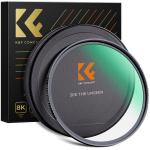
95mm UV Lens Filter HD MCUV Ultraviolet 28 Multi-Coated Filters (Nano-x series Toughened Glass)
SKU: KF01.2527
This has helped with UV protection during the day and has also helped prevent scratches to my camera lens. It is very slim and you can barely tell that its on. I am also able to put my lens cover on it so that it does not get damaged. Worth the investment


11/08/2025
Made from high-quality materials. Precisely built. It offered the least amount of resistance I've had screwing on a new filter. It's very thin so it won't interfere with wide-angle lenses (as much as is possible).
Using a full-frame DSLR, I did side-by-side, pixel-level comparisons between shots with no filter and with this. One photo was a wide-angle shot the included sky on a high-UV day.
Results: well, I didn't see any difference in color or richness in the high-UV shot, so I wouldn't buy it just for that. Mostly, people buy these simply as lens protectors (and trust me, they've saved my bacon on a high-end lenses several times now!). As a lens protector, you want it to be as unobtrusive as possible and I am pleased to report that I can detect no significant difference with any test shot - color balance, sharpness, contrast - they all are so close that I could never say definitively that any minuscule difference was due to the filter.
A very high-quality product with (presumably) a good level of protection. The packaging and case also convey a feeling of quality and pride in their product.
Using a full-frame DSLR, I did side-by-side, pixel-level comparisons between shots with no filter and with this. One photo was a wide-angle shot the included sky on a high-UV day.
Results: well, I didn't see any difference in color or richness in the high-UV shot, so I wouldn't buy it just for that. Mostly, people buy these simply as lens protectors (and trust me, they've saved my bacon on a high-end lenses several times now!). As a lens protector, you want it to be as unobtrusive as possible and I am pleased to report that I can detect no significant difference with any test shot - color balance, sharpness, contrast - they all are so close that I could never say definitively that any minuscule difference was due to the filter.
A very high-quality product with (presumably) a good level of protection. The packaging and case also convey a feeling of quality and pride in their product.
10/08/2025
While a clear filter may not be the most exciting bit of camera gear, it can prove valuable in protecting your expensive lens investment. This filter seems optically clear and does not add any color cast. From my readings I barely see any light loss, nor have I run into internal reflections. The filter has some grip indents on the outside which make it easy to install and remove. Many of my older filters would become stuck and difficult to remove, but I don't anticipate that with this one. It is not overly thin, but I have not discovered any vignetting with this at the wide end of my 24-70 Lumix S Pro lens.
If you tend to shoot in harsh environments, or anywhere that may cause contact with your front lens element, seriously give this some consideration. It's affordable protection worth having.
If you tend to shoot in harsh environments, or anywhere that may cause contact with your front lens element, seriously give this some consideration. It's affordable protection worth having.
22/07/2025
it fits right in and felt protective. Also I am able to rest in peace for the lence
21/07/2025
UV filters are a lot more useful for film as UV affects film way more. However this is still useful for protection, both from UV if you are shooting a lot and also from dust and other particles. There is almost no visible difference between having it on vs having it off in most circumstances so if you want a little more protection on your lens, this is perfect for you.
20/07/2025
A UV filter may help the look of some outdoor photos in bright sun, but honestly I can't see much difference. I use UV filters like most people do, as a way to protect the front element of my lenses. If you're shooting someplace where the lens could get stuff on it, like in the rain, at the beach (salt spray), or the pool (splashes), at a party where people might be getting sloppy with drinks or around kids/pets who might reach out and touch the lens, a UV filter is good protection. It's much easier to clean a filter than the element on an expensive lens!
Of course for this purpose you want a filter that won't degrade the quality of your images, so far as I can tell this one does not. I haven't noticed any visible darkening or color shifts, in fact when I first opened the box for a second I thought there wasn't any glass in the filter ring! So overall I think this will offer some protection to your lenses without changing picture quality. And of course, if you're someplace that isn't hazardous to your lens you can easily take the filter off.
While it's not a downside, I do kind of wish K&F would standardize their filter cases. I have received 3 different kinds already, and it would be nice if they had a stamp/sticker on the outside so you can quickly tell which type of filter is in the box! Luckily, I have a label maker.
Of course for this purpose you want a filter that won't degrade the quality of your images, so far as I can tell this one does not. I haven't noticed any visible darkening or color shifts, in fact when I first opened the box for a second I thought there wasn't any glass in the filter ring! So overall I think this will offer some protection to your lenses without changing picture quality. And of course, if you're someplace that isn't hazardous to your lens you can easily take the filter off.
While it's not a downside, I do kind of wish K&F would standardize their filter cases. I have received 3 different kinds already, and it would be nice if they had a stamp/sticker on the outside so you can quickly tell which type of filter is in the box! Luckily, I have a label maker.
14/07/2025
UV Filters are commonly used to prevent extended UV rays on the front element of a lens, and as a long time photographer, I recall the days when a UV filter was kind of a must-have, for protecting your lenses, long term... or at least that was the theory.
Unfortunately, much of that belief still continues to this day, and while the merits of a UV filter offering protection, are still very much a hotly debated subject, UV filters DO offer one very good benefit... they keep dirt/grime/fingerprints off the main front element of a camera lens.
In case of wedding photography, it's not that unheard of for a child/baby/drunk-adult to reach out and attempt to touch your lens... in fact, the attempts to do so, can produce some of the most incredible shots, if timed right.
However, the cost and difficulty to clean a good high end lens, is often a scale harder than simply cleaning a lens cover on the front... which is where UV filters tend to come in... they do a good job of keeping direct contact off of the actual lens.
I've used many different types of filters over my decades of photography, and among those, UV filters are probably the ones that have the most quality range with them.
This is the first K&F filter I've used, and I've been using it on a Sigma ART lens for the last week.
I'm happy say, this filter is a nice middle to upper range UV protector. Unlike so many of the cheaper UV filters, this one doesn't seem to introduce any readily noticeable color shift, or image distortion with the image.
While I'm sure, if I start pixel peeping, and comparing this UV filter to a >$200 one, I could probably find a few flaws here and there.. the fact is, this filter is half the cost of many of the other upper middle range filters.
... and lets face it. A UV filter's primary goal, is protection. It decent UV filter shouldn't be altering your images in any noticeable way. So to that end, this product does EXACTLY what it's supposed to do.
One thing the K&F DOES excel in, however, is the case the filter is packaged in.
The case is a hard cylindrical case, with an easy twist open. However, the nicer aspect of this filter, is the fact that the case has a silicone ring, with grooves in it, that holds the filter in place, while inside the case. This is something that many other manufactures DON'T do (including a large number of rather high end filter manufacturers)
While yes, this is the first real experience with a K&F Filter, for me... after looking at the attention to detail they've done, I'm now in the market for a few others of theirs :)
Unfortunately, much of that belief still continues to this day, and while the merits of a UV filter offering protection, are still very much a hotly debated subject, UV filters DO offer one very good benefit... they keep dirt/grime/fingerprints off the main front element of a camera lens.
In case of wedding photography, it's not that unheard of for a child/baby/drunk-adult to reach out and attempt to touch your lens... in fact, the attempts to do so, can produce some of the most incredible shots, if timed right.
However, the cost and difficulty to clean a good high end lens, is often a scale harder than simply cleaning a lens cover on the front... which is where UV filters tend to come in... they do a good job of keeping direct contact off of the actual lens.
I've used many different types of filters over my decades of photography, and among those, UV filters are probably the ones that have the most quality range with them.
This is the first K&F filter I've used, and I've been using it on a Sigma ART lens for the last week.
I'm happy say, this filter is a nice middle to upper range UV protector. Unlike so many of the cheaper UV filters, this one doesn't seem to introduce any readily noticeable color shift, or image distortion with the image.
While I'm sure, if I start pixel peeping, and comparing this UV filter to a >$200 one, I could probably find a few flaws here and there.. the fact is, this filter is half the cost of many of the other upper middle range filters.
... and lets face it. A UV filter's primary goal, is protection. It decent UV filter shouldn't be altering your images in any noticeable way. So to that end, this product does EXACTLY what it's supposed to do.
One thing the K&F DOES excel in, however, is the case the filter is packaged in.
The case is a hard cylindrical case, with an easy twist open. However, the nicer aspect of this filter, is the fact that the case has a silicone ring, with grooves in it, that holds the filter in place, while inside the case. This is something that many other manufactures DON'T do (including a large number of rather high end filter manufacturers)
While yes, this is the first real experience with a K&F Filter, for me... after looking at the attention to detail they've done, I'm now in the market for a few others of theirs :)
07/07/2025
This makes the pictures somewhat more vibrant and clear. My daughter, who is the photographer, loves it.
07/07/2025
Speaking of myths, just what do UV filters do?
Originally, UV filters, and their cousins, haze filters, were placed in front of the lens to mollify the effects of UV light on panchromatic and color film, given its proximity to blue on the light spectrum. This is not an issue in digital photography.
Some (here) say a UV filter will prevent UV degradation of the lens or its coatings. Interesting but I have never heard this claim and could not find any knowledgeable photographer making it via a web search.
Some say a UV filter can protect a lens from breaking if dropped. Most photographers/lens manufacturers agree that today’s lenses are far more sturdy than a UV filter, which very well may break if the lens is dropped.
Some say a UV filter may cause flare or ghosting (especially in high contrasting scenes) in the final image. Most photographers report that such an occurrence, if it happens, is hardly noticeable.
For all intent and purposes in digital photography, UV filters serve one purpose: prevent scratches and foreign matter from coming into contact with the front element of the lens. The point being that dust, sand, saliva, sweat, rain, snow, salt spray, et al., are easier to clean from a filter than a lens, while saving the lens from relentless, potentially abrasive cleaning regimes.
I obtained this filter to test for chromatic aberrations, flare, and ghosting – while using it for lens protection. I did not notice any significant effects. If I wish to be picky, very high contrast scenes (bright lights on a dimly lit street) may evidence a bit of ghosting. The filter is well-made, sturdy, and has no visible flaws in the glass or coatings.
Without meaning to demean anyone, I suspect that the average photographer would not recognize any ill effects in their images due to this filter. I obtained the 72 mm which I recommend without reservations.
Originally, UV filters, and their cousins, haze filters, were placed in front of the lens to mollify the effects of UV light on panchromatic and color film, given its proximity to blue on the light spectrum. This is not an issue in digital photography.
Some (here) say a UV filter will prevent UV degradation of the lens or its coatings. Interesting but I have never heard this claim and could not find any knowledgeable photographer making it via a web search.
Some say a UV filter can protect a lens from breaking if dropped. Most photographers/lens manufacturers agree that today’s lenses are far more sturdy than a UV filter, which very well may break if the lens is dropped.
Some say a UV filter may cause flare or ghosting (especially in high contrasting scenes) in the final image. Most photographers report that such an occurrence, if it happens, is hardly noticeable.
For all intent and purposes in digital photography, UV filters serve one purpose: prevent scratches and foreign matter from coming into contact with the front element of the lens. The point being that dust, sand, saliva, sweat, rain, snow, salt spray, et al., are easier to clean from a filter than a lens, while saving the lens from relentless, potentially abrasive cleaning regimes.
I obtained this filter to test for chromatic aberrations, flare, and ghosting – while using it for lens protection. I did not notice any significant effects. If I wish to be picky, very high contrast scenes (bright lights on a dimly lit street) may evidence a bit of ghosting. The filter is well-made, sturdy, and has no visible flaws in the glass or coatings.
Without meaning to demean anyone, I suspect that the average photographer would not recognize any ill effects in their images due to this filter. I obtained the 72 mm which I recommend without reservations.
06/07/2025
In modern DSLR cameras, there is a huge argument whether UV Filters provide any benefit. I’m in the camp that says there are definite benefits. First, there are arguments that the UV filter can protect the sensor in your camera from long term deterioration caused by UV exposure. Second, a high-quality filter provides a layer of protection to the front of your camera lens. I was taking pictures at a very windy venue, and a door was caught by the wind and smacked the front of my lens before I could catch it. I was lucky that the hit wasn’t worse, but the lens did receive a small chip to the front plastic. This filter is made out of metal, screwed right on, and will protect the front of the lens from this kind of damage in the future. The lens could still get damaged in other ways, but it is a layer of protection from these unexpected bumps. In the future, if the lens gets bumped and the filter gets destroyed, I’ll be grateful that the filter took the hit instead of the lens. The filter is much cheaper to replace!
01/07/2025