Sony A7M5: Upgrades, Features, and Value — Should You Buy It?
Sony’s Alpha lineup has shaped the modern hybrid mirrorless market. The original A7 brought full-frame capability to a compact body, the A7 III became an industry benchmark, and the A7 IV refined that formula with better video and improved ergonomics.
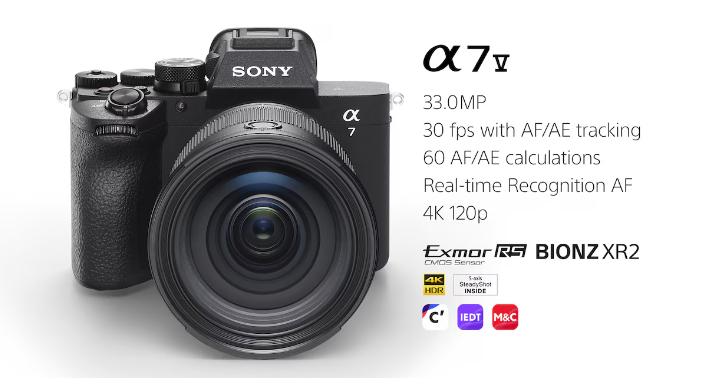
Now, the Sony A7M5 (A7 V) — released on 2 December 2025 — arrives with a clear ambition: to finally blur the line between a professional cinema tool and an everyday hybrid camera.
So, does it set a new standard — and more importantly, is it worth buying?
Key Upgrades: A7M5 vs A7M4
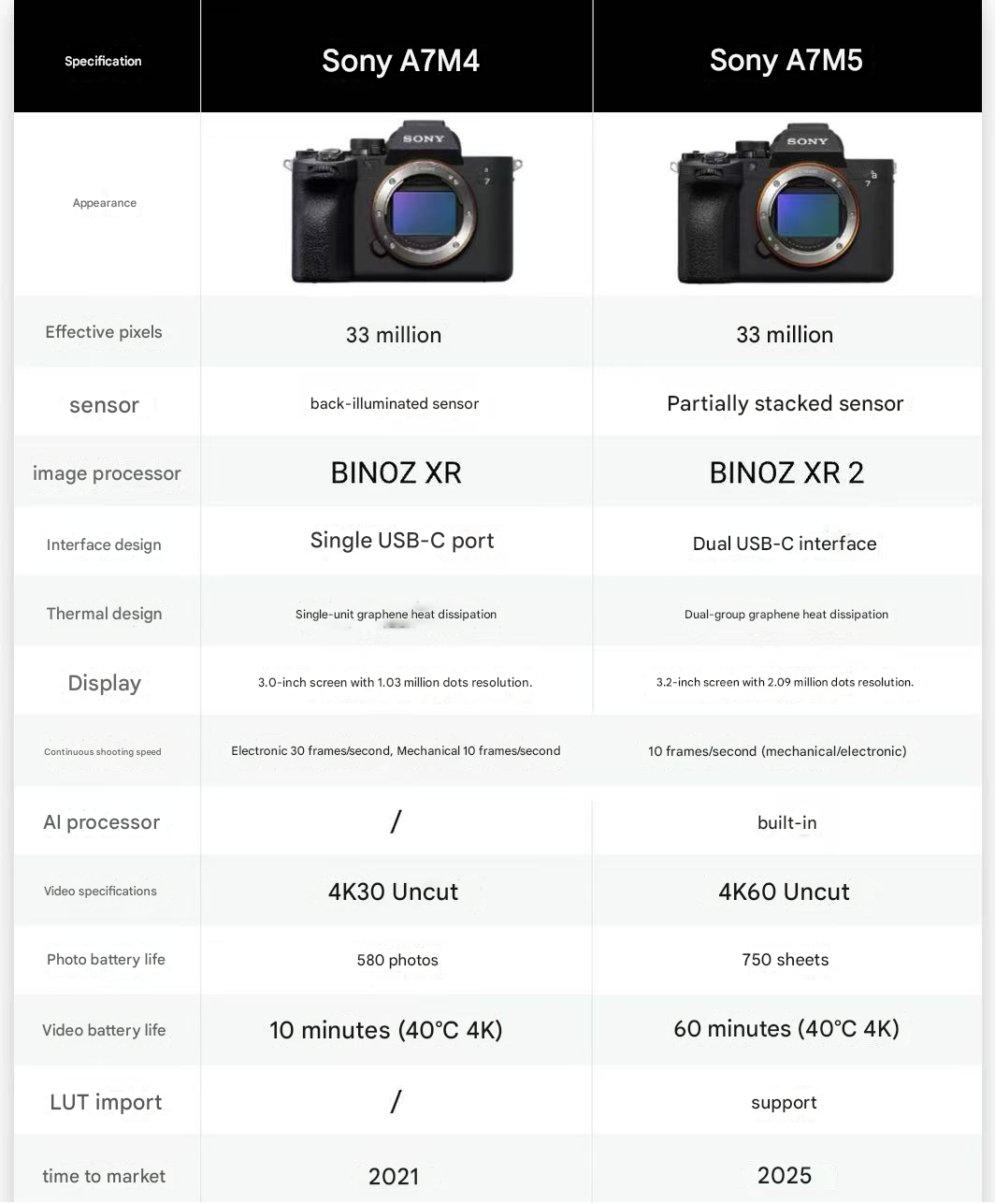 Compared with the A7 IV, the A7M5 introduces several major improvements:
-
Sensor: New 33MP partially-stacked CMOS sensor for faster readout.
-
Autofocus: AI-enhanced subject tracking with improved recognition (humans, animals, insects, moving faces).
-
Burst Speed: Jump from 10 fps to 30 fps electronic RAW bursts.
-
Video: Full-frame 4K 60p (uncropped) and 4K 120p (Super 35 crop).
-
Processing: Updated to BIONZ XR2+, improving buffer handling and AF intelligence.
-
Thermal Performance: Longer recording time in warm environments.
-
Design: Dual USB-C ports and a redesigned vari-angle screen.
These upgrades push the A7M5 closer to Sony’s premium A1 and A9 series performance—at a significantly lower price.

Still Photography Performance
The most notable upgrade for photographers is the 30fps burst shooting, enabled by the new partially stacked sensor. In 14-bit RAW mode, the A7M5 can shoot up to 75 frames before the buffer slows to around 8fps — a clear improvement, though not limitless like Sony’s flagship models.
Sony also claims up to 16 stops of dynamic range (mechanical shutter). Early results suggest electronic shutter quality still trails mechanical in maximum detail retention, though rolling shutter has been reduced significantly from the A7 IV.
For wildlife, sports, street, and event shooters — this generation finally introduces high-speed shooting to the mid-range Sony tier.
Video Performance Improvements
On the video side, the A7M5 addresses several long-standing user complaints.
-
4K 60p is now full-frame and oversampled from 7K.
-
4K 120p is available, though with a 1.5× crop (Super 35).
-
Improved autofocus behaviour in video mode thanks to AI subject mapping.
-
A new 4K Priority View assists framing while maintaining proper noise processing.
The result is a significantly more complete hybrid video system — one that is capable of professional projects, documentaries, and commercial content.
Price and Availability (UK)
The Sony A7M5 launches in the UK at an estimated £2,799 body-only, placing it firmly in the enthusiast-to-professional tier.
Buyers should also consider additional expenses:
-
CFexpress/fast UHS-II cards
-
Extra batteries
-
Large-capacity storage for high-bitrate footage
-
Higher-quality E-mount lenses
While the upfront cost is competitive, the real investment comes from building the workflow around it.
Who Should Buy the A7M5?
✔ Best suited for:
-
Hybrid shooters (photo + video)
-
Wedding, travel, documentary, event creators
-
Semi-pros looking for a long-term system
-
Users upgrading from APS-C or older full-frame bodies
✖ You may want to wait or skip if:
-
You mainly shoot static photos (studio, architecture, landscapes) — the A7 IV remains excellent and may drop in price.
-
You’re budget-focused — the ecosystem cost adds up.
-
You need cine-level features (internal RAW, open-gate, unlimited thermal endurance) — the FX series will still serve you better.
Sony A7M5 vs Canon, Nikon & Sony’s Own Lineup
Against its closest rivals — the Canon R6III and Nikon Z8 — the A7M5 sits competitively in price and hybrid functionality.
-
Canon R6III: Stronger on paper in some areas, but Sony’s lens ecosystem is broader.
-
Nikon Z8: Ideal for photography-first users, while the A7M5 offers better hybrid video options.
Some reviewers are already calling it a “Canon R6 killer.” Whether that holds true will depend on firmware maturity, autofocus real-world behaviour, and adoption among working professionals.
FAQs — Based on Real User Interest
- Is it worth upgrading from the A7 IV if I mainly shoot photos?
Only if you need faster burst shooting, better subject tracking, or reduced rolling shutter. Otherwise, the A7 IV still performs very well. - Is the autofocus noticeably better?
Yes — especially for wildlife, insects, pets, and human tracking in busy environments. - Is it good enough for filmmaking — or do I still need an FX-series body?
For most creators, it’s more than capable. If you need internal RAW or cinema-grade workflow tools, the FX lineup remains superior. - Is it designed for creators or professionals?
It’s intentionally positioned in the middle — approachable for creators, reliable enough for professionals.
Final Verdict: Is It Worth Buying?
If you’re a hybrid shooter — someone who values both photos and video — the Sony A7M5 is one of the most capable full-frame mirrorless cameras in its class. Its improvements make it a genuinely meaningful upgrade for action shooters, filmmakers, and creators who want versatility without jumping to cinema-grade prices.
For casual photographers, the A7 IV (or even A7 III) may still be the smarter value.