
Exploring the new Sony A7M5 camera: What are the upgrades and is it worth buying?
2025-12-05 10:05:54
0 Comments
The Sony Alpha series redefined photography, bringing full-frame quality into a compact form with the original A7. The A7M3 ("A7 III") became the undisputed hybrid benchmark—a reliable workhorse loved for its image quality, autofocus, and battery life. The A7M4 ("A7 IV") refined that legacy, adding higher resolution, 4K 60p video, and a better menu, cementing its role as a true stills-video hybrid.
Now, the A7M5 (“A7 V”), released on December 2nd, is here. It aims to fully bridge the gap between professional cinema-grade video tools and the accessible, daily usability that defines the A7 line. One question remains: does it set the new standard for the hybrid full-frame camera? Let me analyze the main performance improvements of this new machine for you and whether you need it.
A7M5 vs. A7M4: Key Upgrades
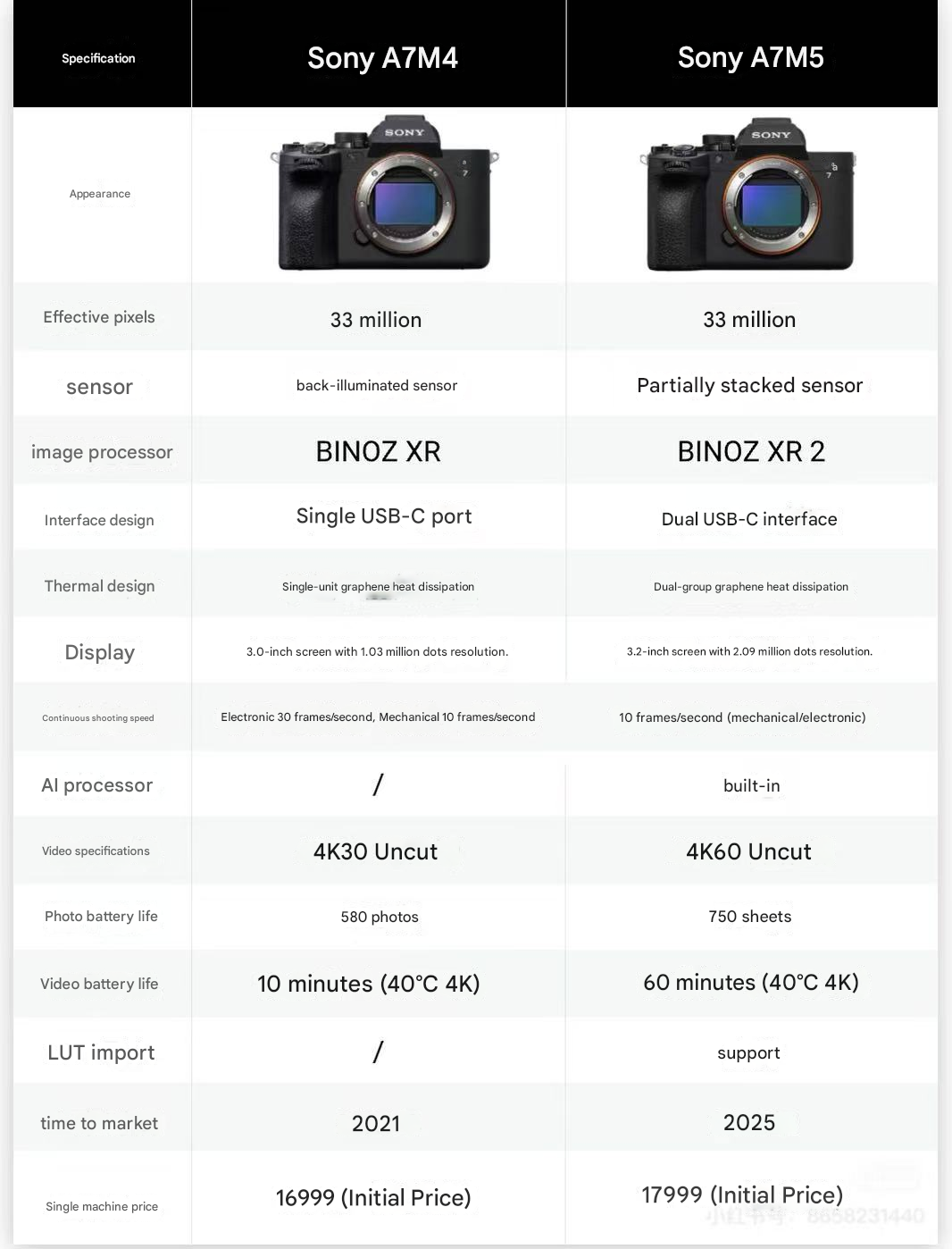
Compared to its predecessor, the A7M4, here's a quick overview of the key upgrades in the Sony A7M5!
[1] Sensor: Upgraded to a 33MP partially stacked sensor, improving speed.
[2] Continuous Shooting: Electronic shutter speed increased from 10fps to 30fps.
[3] Video: Upgraded from 4K 60p (cropping required) to full-frame (uncropped).
[4] Processor and Autofocus: Upgraded to the AI-integrated BIONZ XR2, providing smarter focus recognition.
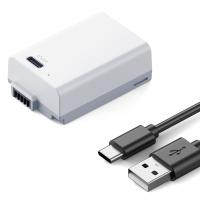
[5] Battery Life: Slightly improved battery life for photos; longer continuous video recording time in high-temperature environments.
[6]Design: Upgraded to dual USB-C ports and a new free-angle flip screen.
The A7M5 debuted with a brand-new 33-megapixel partially stacked CMOS sensor, and the processor was upgraded to the BIONZ XR2+, which are quite significant upgrades.
Improved photo-taking capabilities of the A7M5 camera:
The biggest improvement I see in the A7M5's photography capabilities is its continuous shooting speed. Thanks to the new 33MP partially stacked CMOS sensor, the A7M5's continuous shooting speed is significantly enhanced, reaching 30 frames per second in 14-bit RAW format, with a maximum RAW pre-shooting time of 1 second.
However, the buffer seems rather limited. It's said that the 30 frames per second speed only lasts about 1.5 seconds, then drops to 8 frames per second, meaning the buffer fills up after approximately 75 shots.
Another impressive feature is that the A7M5 has a dynamic range of 16 stops. I even specifically checked the fine print below—"Mechanical shutter only." According to the blogger's review, the image quality under electronic shutter is still not as good as that under mechanical shutter.
Improved video shooting capabilities of the A7M5 camera:
In terms of video, the A7M5 camera offers uncropped 4K 60p, and it's 7K oversampled. It also supports 4K 120p, but it's the S35 sensor, meaning there's still a 1.5x crop. There's a 4K priority view option; turning it on provides a normal full-frame view, while turning it off results in a small crop but better noise reduction. Additionally, thanks to the new processor, video autofocus is said to be significantly improved compared to the A7M4.
Personally, I think one of the biggest significances of the A7M5 is that it fills the gap in high-speed continuous shooting for mid-range cameras, which may be a new standard for hybrid full-frame cameras. Previously, Sony cameras required either the A9 or A1 series for high-speed continuous shooting. Now, a mid-range camera also offers a usable high-speed continuous shooting feature, which is quite important.
A7M5 Camera’s Price, Availability, and Value:
The Sony A7M5 enters the UK market at around £2,799 body-only, positioning it firmly in the enthusiast-to-professional hybrid segment. While the body price is competitive for a full-frame system with advanced autofocus, oversampled 4K recording, and a partially stacked sensor, buyers should also factor in the typical additional investment required—fast UHS-II or CFexpress cards, extra batteries, compatible lenses, and potentially larger storage for high-bitrate video workflows.
Who this A7M5 Camera Is For — And Who Should Skip Or Wait:
Ideal for:
Hybrid shooters: photographers who also shoot video (events, weddings, travel vlogs, documentary, short film). The A7 V’s balance of strong stills performance and credible video makes it a “one-body-does-all” solution.
Enthusiasts and semi-pros wanting a long-term body: if you want a dependable, versatile full-frame camera that grows with you — from travel and portraits to serious video projects.
People who value convenience + flexibility: a single body that handles portraits, landscapes, street, video interviews, run-and-gun shooting, with good autofocus, IBIS, and modern codec support.
Might Skip or Wait If:
You mainly shoot static photography (landscape, studio, architecture) and don’t care about high-end video: the previous model (A7 IV) may already be more than enough — especially if you just need dependable full-frame stills and don’t need 30 fps bursts or oversampled video. Indeed, with A7 V’s launch, older A7 IV bodies may drop significantly in price.
You are on a tight budget: once you include lens, cards, and accessories, the total cost is nontrivial. Entry-level or advanced APS-C/full-frame alternatives may offer better “bang for buck.”
You need pro-level video features (internal RAW, open-gate video, extremely long continuous recording, dedicated cinema workflow) — in that case, a specialized cinema or pro video body might still make more sense than a hybrid.
Is It Worth the Price?
For hybrid creators and serious enthusiasts, the A7 V is worth it — as long as you accept that the “real cost” reaches beyond the bare body.
Sony A7 V vs Canon and Nikon:
The A7M5's performance specifications aren't as good as the Canon R63+, and its price of £2,799 is within expectations. Compared to Canon, the R63's specifications are more appealing on paper, but Sony has a stronger lens lineup. I think each has its own advantages.
The prices of the A7 V and Nikon Z8 are actually not that different. Personally, I think the A7M5 is a better choice if you need more video recording capabilities, while the Z8 is a better option if you take more photos.
FAQs:
1.“Is it worth upgrading from the A7 IV if I mainly shoot photos?”
Only if you need faster burst shooting, improved tracking, or reduced rolling shutter. For general photography, the A7 IV still performs very well, so the upgrade isn’t essential unless you shoot action, wildlife, or events.
2. “Is the autofocus noticeably better than previous Sony models?”
Yes. The new AI-assisted tracking system is faster, more accurate, and better at recognizing complex subjects, especially small animals, insects, and moving faces in busy environments.
3. “Is this camera good enough for filmmaking — or do I still need an FX-series model?”
For most hybrid creators, the A7M5 is fully capable of professional video work. However, if you need advanced cinema tools like internal RAW, open-gate recording, or dedicated heat management, the FX lineup still makes more sense.
4. “Is this a creator-friendly design or a professional tool first?”
It’s a blend of both—flexible enough for vloggers and hybrid content creators, yet powerful and reliable enough for working professionals. The design strikes a middle ground rather than choosing one audience exclusively.
Leave your comment
Note: HTML is not translated!